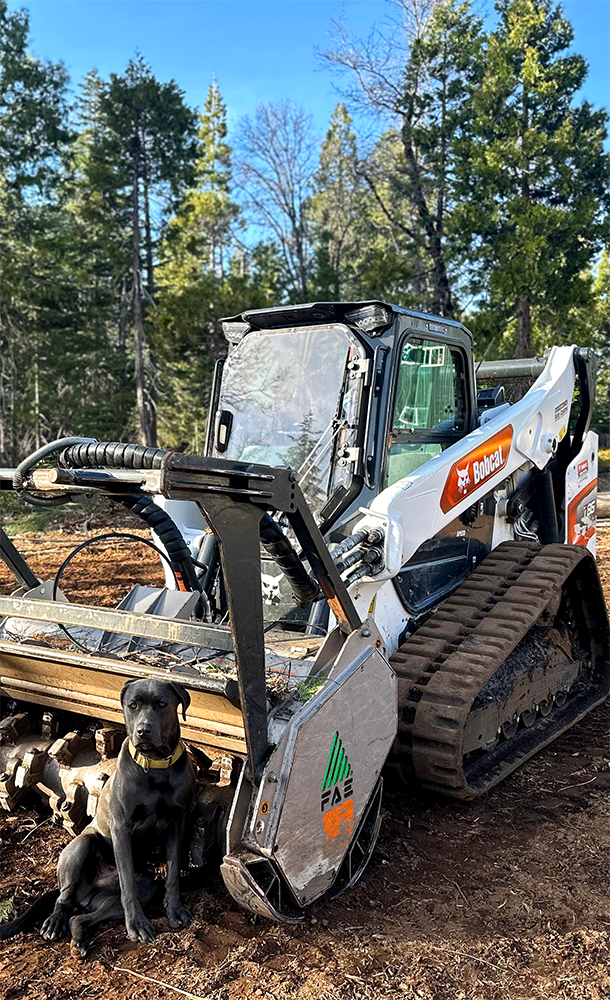
Fire-wise land management for the Sierra
Elevation changes everything. The northern Sierra around Truckee runs at 6,000 feet, with dense conifer forests, deep snowpack winters, and a fire season that starts later but burns hotter than anything in the valley. The lessons of recent regional fires made very clear how fast crown fire moves through unmaintained forest.
Our crews work this terrain with equipment and techniques specific to Sierra conditions. Pine needle accumulation, ladder fuels under conifer crowns, and the spacing between trees are all different conversations than what we'd have on a Central Coast property.
Why mountain properties demand serious attention
The Tahoe Basin and surrounding national forest experience some of the highest fire risk in the state. The combination of dense ponderosa, white fir, lodgepole, and Jeffrey pine, accumulated needle litter, and increasingly dry summers has produced multiple recent fires that came within miles of populated areas.
The Town of Truckee has expanded its defensible space requirements and the local fire-safe councils run aggressive education and chipper programs. Insurance carriers in the basin require evidence of vegetation management or they will not renew policies.
What we do for mountain properties
Brush Clearing
Understory removal, ladder fuel work, and selective thinning under conifer canopy.
Fire Prevention
Zone-based fuel reduction tuned to Sierra conifer behavior and basin wind patterns.
Full Removal
Heavy work for cabins that have been left unmaintained for multiple seasons.
Defensible Space
Code-compliant clearing with documentation for inspections and insurance.
Sierra-specific considerations
Mountain work isn't the same as valley work. We pay close attention to crown spacing between large conifers, surface fuel loading from years of needle drop, the dead understory that gets choked out by canopy, and the bark beetle dynamics that have killed millions of trees in the basin. Hazard trees adjacent to structures require specific approaches and often coordination with arborists for removal beyond our scope.
We also work around the basin's restricted burn windows. Open burning is tightly controlled and the season for any kind of vegetation work is compressed by snow at both ends of the calendar.
Seasonal timing in the high country
Work in Tahoe area properties typically runs May through October. Snowmelt timing varies year to year, and we plan accordingly. Spring is the priority window for defensible space work, before fire restrictions tighten in July. Fall is excellent for chipping, pile work, and final cleanup before snow returns.
The Truckee Donner Chamber of Commerce and the regional fire-safe councils coordinate community days that compress a lot of effort into short windows, but for property-specific work, we book on individual schedules.
What it costs at elevation
Mountain property work is more expensive than valley work for several reasons: travel time, equipment requirements, and the scale of fuel that accumulates in Sierra conifer forest. Residential defensible space packages typically run $2,500 to $8,000 here. Larger parcels with heavy fuel loading run higher. We provide written estimates after on-site walks and explain how we got to every number.
Why Sierra homeowners call us
We understand the basin. Our crews work in coniferous forest with the same care we bring to coastal oak woodland, and we don't treat mountain properties like an afterthought to our valley business. Whether you live here year-round or visit on weekends, your property needs people who know what they're doing in Sierra fuels.
For broader context on the Tahoe region's fire history and ecology, the town's civic history shows how dramatically wildland-urban dynamics have shifted over the past century.